Ryan Foerster: Here Comes the Sun
January 17 - February 28, 2026
installation images selected works thumbnails
Press Release
Ryan Foerster
Here Comes the Sun
January 17 - February 28, 2026
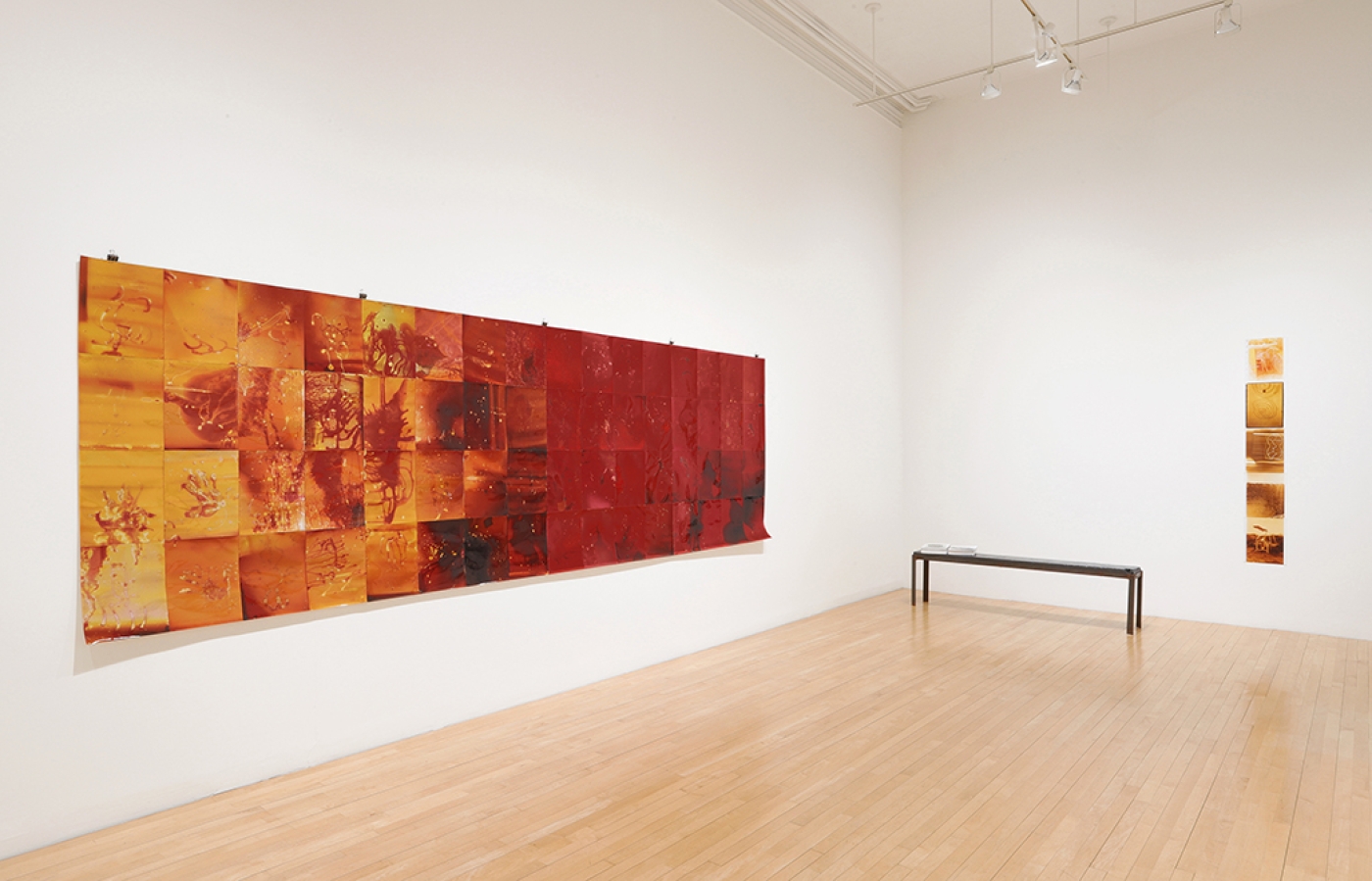
Kerry Schuss Gallery is pleased to present Here Comes the Sun, a solo exhibition of new photographic works by New York-based artist Ryan Foerster. Marking a return to the artist’s engagement with photograms, the exhibition centers on a large-scale work composed of sixty-four pieces of photo sensitive paper, produced in Foerster’s Brighton Beach home while he was in Europe over the summer of 2025. During this period of travel, Foerster also made a series of color photographs documenting his time away and his various encounters. This series of work was created in tandem with another durational project in Paris, where Foerster temporarily occupied a bookseller’s stand along the banks of the Seine, using it as a site to present his self-published zines and to host improvised exhibitions and happenings.
---------------------------------------------------------------------------------------
There are different kinds of encounters with sunrise. The sun that emerges from the clouds, an overwrought metaphor for a turn in mood or fortune. The dawn that brings a quotidian beginning, a promise the day’s tasks might in fact get done or the hours might pass in a way that feels untethered to any burden. And then there is the rising light after a prolonged night out with its pangs of guilt and dread: why am I still awake? Have I really not gone to sleep yet?
Each of these belongs to the same rhythms of time, one singular time, but a time with distinct punctuations.
In the summer of 2025, Ryan Foerster left his home in Brighton Beach to spend four months in Europe. Across the floor of his studio space, inside his house, he laid out 64 sheets of expired Fuji paper, covering every surface, nearly a verbatim, to- ratio stand-in for his workspace. The light-sensitive paper was left inside rather than outside (usually Foerster makes these photograms in his garden), but it was still exposed to light and darkness through the windows and the intensely humid New York City summer heat. For the duration of his time away, the photograms developed, the angle of sun and shadow corresponding to the amount of light, what we typically consider aperture.
It was a prolonged duration, but also an ellipsis. Foerster’s history with photograms dates back 15 years, though he stopped publicly exhibiting these works about a decade ago. In this sense it was a return. And while this return was happening, he left, and during his physical absence from home, during his travels, the other works in the show came to be.
Early on in the trip there was a period of personal grief and loss. Foerster soon found himself at Dial House in England, where a new garden was entered. While in the company members of Crass, a band whose ethos was important to him in his youth, these octogenarian artists, still anarcho-pacifists living off the grid, growing their own food, Foerster made drawings and took photographs. He also tended to their roof, helping to mend a skylight. Band member Penny showed him an abandoned bunker, dating back before WWI, where a network of tunnels became the canvas for decades of graffiti.
In Paris on the banks of the Seine, Foerster set up shop at an abandoned Bouquiniste stand, showcasing his zines and staging short-term exhibitions and happenings. After a few days, some of the resident booksellers volunteered to help clear the trash from the inside of the stand, all documented in a publication Foerster later assembled. In Foerster’s work, trash never decomposes; it regenerates to find new life within the same progression of time. It does not go to ruin.
Ruins, the ancient kind, made a cameo during these summer travels. A vestige of a Roman arena in Arles set the scene for a ritual not as old as the structure, but still strange and historic. Foerster anticipated a bull fight, but in fact no bulls were killed: instead a peculiar dance unfolded as the participants, clad in white, ran in circles, trying to grab string off the horns of the bull; their clothing becoming sullied in this almost ceremonial dance.
The photographs during these travels were shot on expired black and white film that he was given, though they were printed in color. The result is a color akin to something aged by the sun.
In a pair of black photograms, made before he set off for his summer adventure, discarded packaging, string, and an outline of the artist’s shoe sole float suspended, as if in a parallel galaxy. It’s almost prescient, or even prophetic: this could be the wrapper from the bookseller’s stall, the twine pulled from the bull’s horn. A footprint left in the garden, tended and untended. Acts of chance and radical care.
text by Sabrina Tamar
Ryan Foerster (b. 1983, Newmarket, Canada) lives and works in New York. Recent solo exhibitions include Here Comes the Sun at Kerry Schuss Gallery, New York (2026); Dü späti Review at 3A Gallery, New York (2025); GREAY MATTER at Cooper Cole, Toronto (2024); Homeward Bound and Triumphant Return of Ziggy Stardust presented by FIERMAN at Diana, New York (2023); ZOLTOG 99 at Shoot the Lobster, New York (2022); FRICTIONAL ARCHAEOLOGY at Martos Gallery, New York (2022); Ryan Foerster at C L E A R I N G, New York (2021); among others. He has participated in numerous group exhibitions at venues such C L E A R I N G, New York and Beverly Hills; White Columns, New York; The Box, Los Angeles; Mitchell Algus Gallery, New York; Lubov, New York; Tee Drawing Center, New York; Galerie Crone, Vienna; and Apalazzo Gallery, Brescia. In 2017, he received a Canada Council for the Arts Travel Grant. In 2013, he was awarded the Artadia and New Art Dealers Alliance Award. In 2012, he received support from the Pollock-Krasner Foundation, New York Foundation for the Arts, Joan Mitchell Foundation, and Foundation for Contemporary Arts. His work is held in public and private collections including the Rubell Museum, CELINE Paris, and Southeastern Community College, Iowa.